Saturday, 14 April 2012

Rb in Ethiopia / Cycle 4

Chemo cycle 4 has been hard, as Asa struggled to tolerate a raised dosage of one of the chemo drugs, and was hospitalized for four days over Easter.  I was in Ethiopia during much of this.

At the beginning, Asa was relatively happy in the daytime, but during the nights he was clearly uncomfortable. Paracetamol did nothing to relieve his discomfort, and Codeine worked only for brief periods.  Saddest of all to see, he wanted desperately to breastfeed, but as soon as Selam’s nipple was in his mouth, he would be overcome with nausea and retch or vomit. 

The dosage of Vincristine had been raised from 50% to 75%, and it’s an indication of how powerful this drug is that an additional 0.19 mg. should make such a massive difference in terms of side effects.  Our experience with the lower dosage had made us feel pretty confident about chemotherapy – “We can handle this!” – but this cycle put us back on the defensive again.

That was the state of play when I left for Ethiopia on the Sunday before Easter. 

It was a great relief to hear, after I arrived, that Asa had stopped vomiting and was breastfeeding again. 

Housekeeping

One of the jobs I had to do in Ethiopia was to gather things from the apartment in Addis Ababa that we’d left in January.

Since we left, Selam’s aunt Birritu had moved our stuff to another apartment, and when I got there I was surprised to find that she’d arranged the new apartment exactly like the old one – everything down to the fridge magnets and the books on the shelves was in its place.


A note on the fridge.


It was moving to be surrounded by those things again, and it reminded me of how incredibly easy life had been for us – even if we hadn’t fully appreciated it – before Asa’s diagnosis.

Rb in Ethiopia

Another job was to see Dr Abonesh, the ophthalmologist who’d first confirmed Selam’s suspicion of Retinoblastoma, and to learn more from her about Rb in Ethiopia.

I met Dr Abonesh at the private practice where she works, and we chatted for a half hour as several patients waited outside her door.

Dr Abonesh estimated that she’d seen 10 cases of Rb per year during the 8 years that she worked at Menelik II Hospital, the country’s main referral centre for eye problems.  The children came from all over the country, she said.  Most arrived with proptosis (protruding eyes), and when parents were told that the eyes should be removed, they would often disappear in denial, sometimes coming back when there was a protruding mass that needed to be cut out, but more often not returning at all.

Dr Abonesh knew of only two success stories – children who’d been diagnosed relatively early, and who’d traveled to Kenya for surgery.  Both had had their eyes removed, but were doing well since. 

So the short answer to our question, “What would have happened to Asa if he’d been in Ethiopia?” is that he too would have had his eyes removed.

When I told Dr Abonesh that we were interested in helping children diagnosed with Rb in Ethiopia, she suggested something we hadn’t thought of before. 

In the UK, there are several organizations that provide accommodation and transport services for families whose children need urgent medical treatment – the Sick Children’s Trust, which accommodates families from out of town whose children are receiving treatment in London; and CLIC Sargent and a government benefit scheme, which help with transport costs.  But in Ethiopia, where the challenges for families are so much greater, we don’t know of any equivalent. 

Contributing to a transport fund for families who need to travel to Addis Ababa for treatment would be one way to make their burden lighter. 

Of course transport and accommodation aren’t the only things that are needed.  Raising awareness among regional medical personnel and improving doctor-patient communication would be helpful too.  Not to mention making available the drugs that Asa’s receiving. 

But transport is at least an area where one could make a difference with a small investment. 

The day after I met with Dr Abonesh, I took a bus to Jimma in southwest Ethiopia, where I’d done my PhD research.  The cost of the ticket from Addis to Jimma is 100 Birr (about $6) – Not much to us, but a considerable sum to many Ethiopians.

Addis Ababa central bus station at dawn


Asa’s trials

While I was in Jimma, Asa came down with a fever and was admitted to hospital in Colchester.  He was placed on antibiotics, and over the following 3 days he had transfusions of red blood cells and platelets when his counts dipped below the danger thresholds.

He’d been admitted on Good Friday, and when I arrived home on Easter Monday he was close to being discharged.

He’d eaten almost nothing during the entirety of my time away, surviving on cow’s milk delivered through his NG tube and breastmilk, and an occasional slice of orange or spoonful of vitamin syrup.

His hair, which had thinned out somewhat in previous cycles of chemo, was reduced to a sort of tennis ball fuzz, and his eyebrows had almost disappeared.

Staying positive

The good energy we’ve received from family and friends has helped us stay strong as Asa goes through all this.

Last month some dozens of friends sent us photos of themselves bearing good wishes for Asa (see here!). 

To them we send the following message:


As we reach the last days of cycle 4, Asa’s appetite is starting to revive.  On Wednesday he ate a full meal (his granddad’s chicken and veg) for the first time in more than 10 days, and since then he’s accepted small amounts of food by mouth.  This morning, with much cajoling and patience on his mum’s part, he finished his breakfast.

But even when he’s not eating, Asa’s liveliness is extraordinary.  Despite all the poisons in his bloodstream, and the negligible nutrition he gets, he somehow mobilizes great energy for exploration and play. 

As we sit on our bed, writing this, he is crawling all over us and biting random parts of our bodies.

Much love from us and our balding but lively 14-month-old to you all.


Sunday, 25 March 2012

RB genetics ... What would happen in Ethiopia?


Retinoblastoma is a complicated business. It’s not uncommon for us to ask a question of a doctor, only to be told, "Ah, that's a question for Dr X."

The team that manages Asa’s treatment includes ophthalmologists, oncologists, and geneticists – each of whom contributes a piece of the puzzle.

As it turns out, some of our questions about the causes of Rb and its long-term implications are questions for geneticists.

Genetics is relevant here because, given that both Asa's eyes are affected, there's a very high likelihood that it’s due to a mutation in a gene known as RB1. 

Dr Rosser, a geneticist at Great Ormond Street Hospital, helped us understand how this mutation might have arisen, and what its implications are.

Since neither Selam nor I have relatives with Rb, the most likely way Asa got the mutation is through a random change in the sperm or egg that made him.

As Dr Rosser explained: "Every time a cell divides, 40,000 genes get copied.”

“All of us have 20-50 mistakes in every gene, but most don’t matter.

“His matters."

It’s kind of a relief to know that genetic mutations are common – that we all have them.  And that they’re not always bad news.

But obviously some are more important than others.

How does Asa’s matter? 

How (not) to build a retina

One of the major jobs genes do is to give instructions on how to build a body.  Genes have relatively specialised tasks, and the job of the RB gene is to issue the command, "Stop growing, retina." When there's a mutation in this gene, the "stop" command doesn’t register, and cells keep dividing in the retina area, more than are needed. (Retinoblastoma literally means growth on the retina – blastos being Greek for bud or growth.)

Eye anatomy, showing the retina (from visionandeyecare.wordpress.com)

Since the retina does most of its developing by age 5 – and most of that during the first two and a half years – Asa will be at greatest risk from Rb during the first 5 years of his life.  After that, according to Dr Rosser, he will have about a 6% chance of other tumours, e.g. in bones, muscle or skin, with the risk peaking in his teens or early 20s, and declining thereafter.

There are two other corollaries of RB mutation: it may be accompanied by other mutations, and it can be passed on to children.
 
Sometimes when the RB gene isn’t working, it’s the first sign that there are other abnormalities: neighbouring genes could also be faulty, and these could lead to other problems in development.  We will have to keep an eye out for developmental oddities in Asa.  The fact that he’s developing normally so far (he started walking independently this week!) bodes well.

There’s a 50:50 chance that Asa’s children might inherit the RB mutation.  Knowing this, however, means that any child he might have could receive prompt evaluation and, if necessary, treatment to nip tumours in the bud.


How common is Rb?

For some reason, the copying mistake that leads to the RB mutation happens at a fairly predictable rate across human populations.  The figure that's often cited is 1 in 20,000 (50 in a million). 

The universality of this phenomenon can be difficult to believe, because almost everything you see on the internet (and we’ve spent some months searching) is related to Rb in Europe and North America.

In Europe, we learned recently, there’s some variation, with slightly higher incidence rates in the north than the south (MacCarthy et al. 2006).

But if it occurs at roughly the same rate all over the world, how come we don’t hear more about Rb in Asia, Africa, and South America?  

Some possible answers are that high child mortality from infectious diseases in the developing world makes cancer a marginal concern; there are a lot more resources available for cancer treatment in the West; and the internet is Eurocentric.

Still, we wonder.  Are there really thousands of children born with Rb in the developing world?  What happens to them?

What would Asa’s chances of survival have been if he was in Ethiopia?

Rb worldwide

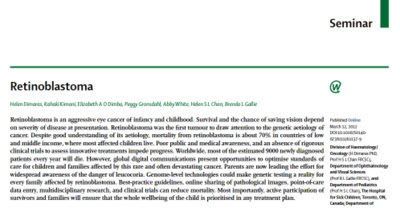
This month, a review was published in the Lancet by a team of physicians in Canada and Kenya (Dimaras et al. 2012).


Their review doesn’t confirm the 1 in 20,000 incidence rate, but it does show that there’s a lot of Rb in other parts of the world.

In Kenya (one of the few countries in Africa where there is a dedicated treatment centre for Rb) more than 70% of children with Rb die from it. The mortality rate from Rb is surely higher in places where there are no treatment centres.

What happens when Rb goes untreated is quite horrific.  The Lancet article includes a photograph of a child with a very large tumour that has burst out of the eye socket.

Ethiopia is one of the places that lacks a treatment centre.  While we don’t know how many children in Ethiopia have Rb, the ophthalmologist in Addis Ababa who first diagnosed Asa, had referred patients to Kenya. 

And as the second most populous country in Africa, Ethiopia usually comes close to the top of the list when cases of disease are tallied up.

So given what we know about the genetic basis of Rb, and its regular incidence rate, it seems likely that there are scores of children being born with Rb in Ethiopia, most of whom will die of it.

Selam and I would like to help families there whose children have Rb get treatment. Next week I’m going to Ethiopia, and I’ll try to find out more about how we might do this. 

Sources:

A recent article documents the commonness of genetic mutations, and suggests that most do not have any major consequences for health (MacArthur et al. 2012, Science 335, 6070:823-8; news item here). 
 

Incidence of retinoblastoma higher in northern than southern Europe (MacCarthy et al.2006, European Journal of Cancer 42, 13: 2092–2102)

Lancet review of retinoblastoma (Dimaras et al. 2012, Lancet 2012, doi:10.1016/S0140-6736(11)61137-9)

Thanks to Charlotte Kvasnovsky for letting us know about the Lancet review.

Saturday, 17 March 2012

"What's the prognosis?"

The examination under anaesthetic last week revealed that the tumours in Asa’s eyes have halved in size in the left eye and more than halved in the right eye since he began chemo.

Retina scans showing tumours before and after the first two cycles of systemic chemotherapy.

The retcam images show how the tumours have shrunk, and also changes in texture from diffuse blobs to gnarly, calcified masses.
 
This is encouraging, but there’s still a lot of cause for concern.

For one thing, systemic chemo has its greatest effects in the first cycles.  So unfortunately we can’t expect this rate of shrinkage to continue through the remaining 4 cycles of chemo. As the ophthalmologist told us, the remaining chemotherapy is to prevent relapse.

The other cause for concern is seeding. 

In the images, the constellations of little spots around the tumours are “seeds”: tumours-in-the-making that, if they’re not attacked, will grow bigger.  These are a worry because (a) they’re so many of them and (b) they’re not well supplied by blood vessels, the way the big tumours were, so they won’t respond as well to systemic chemo, which relies on the circulatory system to deliver the drugs.

The seeds can be attacked in a variety of ways, including laser and cyrotherapy.

But there’s a delicate balance to be struck between the benefits these treatments can bring in terms of destroying the seeds, and the collateral damage they can cause in the process.  Aggressive use of laser, for instance, might inactivate the seeds, but could also further detach the retina, which would cause problems of its own.

This is part of the reason why, after this first course of chemotherapy ends, Asa’s going to need to be examined under anaesthetic every month or 2 months for the next few years.  The doctors will be trying to keep these seeds under control, using an appropriate level of focused therapy.

Where we are now

The day after the examination under anaesthetic, Asa received his third dose of chemo.  

Now we have three down; three more to go.


Asa and parents at the new Royal London Hospital, in Whitechapel


Monday, 5 March 2012


Last week Asa's blood counts -- specifically, his neutrophil count -- didn't return to normal in time for him to undergo his eye exam and begin the 3rd round of chemo. Our medical appointments were pushed back a week, and in the meantime we've enjoyed a lull, waiting things out, and hoping the neutrophils are climbing, but also getting more time and space to reflect on life than we've had for the last couple of months.

The first time Asa’s neutrophils fell below 1.0, during the first cycle of chemo, we were thrown into a panic, and half expected him to break out in spots or immediately develop a fever.  Since then we’ve learned that the danger is manageable.

Neutrophils are one component of white blood cells, which indicate your body's ability to withstand infections.  The chemo drugs Asa is taking inhibit his ability to produce white blood cells, and consequently his immune system is seriously depressed for a while after each dose.  During the first cycle they plunged after 9 days, and then returned to normal by day 20 or so. This time they fell more rapidly and stayed down for longer. 

The implications for our day to day life aren't all that great: We've been taking precautions to protect him from infections, and we don't get out much: an excursion to the shops every now and then or a walk in the countryside when the weather's fine is about as adventurous as we get.

One of the precautions we take – keeping Asa (and sometimes Selam) penned in


This has become our normal routine now, so we're used to it.  And so far we've been lucky this time around -- no fevers, no scary coughs, no inflammation around the Hickman line.…

The downside of up

At first, the absence of crisis was a bit difficult to deal with.  When you've been putting out fires for weeks on end, it feels weird not to have an emergency on your hands.  And the first week or so after Asa's appetite returned, when he seemed to be pulling back and was acting (as he still is now) pretty much like any other toddler, saw us struggling much more than we'd expected, with worries bubbling up.  Your mind goes strange places under these circumstances -- you start wondering how long all this treatment is going to last.  How you’ll get your own career back on track.  How nice it would be to return to Ethiopia.  And what it would be like if Asa were really to lose his sight….

We started searching for more information from other families who had children with Rb, and how things had worked out for them. 

This has been a sobering exercise, and the stories make difficult reading.  The first 6 months of chemo are never the end of the road, at least in the cases we've heard about.  There are long periods when children are getting regular eye exams under anaesthetic, doctors are spotting new tumours, and children are receiving focused therapies like cryo, laser, and radioactive plaque… 

And sometimes, after all this, removal of one or both eyes is necessary.

The blog that we've learned most from is Fintan Tadgh's.  Maintained by his parents James and Fiona, it tells the story of their journey from Fintan’s diagnosis in 2007, when he was 6 months old, through an EUA last week, at the age of 4.

Fintan and his family have been through a lot, and learned a lot, over the years.  Following them through this, reading a year's worth of posts each evening last week, we empathised as they took a roller coaster ride through periods when it looked like Fintan’s cancer was on the ebb, through times when it was resurgent, and through many and various treatments, all of which they suffered with great strength and dignity.

At the moment, we can’t tell how closely Asa’s story will resemble Fintan’s.  We expect we’ll get more information when we see Mr Reddy, the consultant ophthalogist at the Royal London Hospital on Wednesday.  And while we’re hoping for good news on how the chemo’s working, we know that this won’t be the final judgment, and there are likely to be more surprises ahead.

For the time being, we’ve attained a certain amount of equanimity, and the past few days have been as good as any I can remember of late. 


Asa's been developing in new and surprising ways: imitating sounds, walking more confidently each day, fussing for our attention (are we spoiling him??), and kissing us (wetly and smack on the mouth).   

And we've felt more lighthearted than we have for a long time, one sign of which is our ability to laugh at things that would have caused us to freak out just a week or two ago -- for example, me tracking dog shit into the house one day… Not a great move at the best of times, but especially not when you've got a severely immune compromised toddler in the house. 

Friday, 24 February 2012

The second cycle

 
Two weeks ago, Asa had his second dose of chemotherapy. So far, the second cycle has been much easier than the first. We’ve managed to stay at home except for short visits to hospital, and we've largely succeeded in controlling Asa's discomfort. 

Part of the reason for this is that we’ve been giving him potassium supplements to head off hypokalaemia, whereas the first time around it was several days before we began using potassium. But a bigger reason is that the dosage of the most potent of the drugs he is on – Vincristine – has been halved.

Halving the dosage of this drug is a big deal, because our most immediate challenge is managing the side-effects of the chemo drugs.

In the first cycle that meant trying to distract him from pain.  This time it's mainly meant trying to get him to eat. 

Asa feeding Jed feeding Asa....  Oranges are the only food he's never refused.


Expecting that Asa might have difficulty feeding, we had a naso-gastric tube inserted just a couple of days after the second dose of chemo.  The tube is useful not only for topping him up with food when he’s not taking anything by mouth, but also for giving him anti-nausea medicines and potassium syrup (which can themselves be nauseating to swallow).

Thankfully, he has been breastfeeding well throughout.

In this way we’ve been able to get him through the rough first few days of the cycle, until his appetite starts to revive.

Blood counts

Next week, we'll learn whether the drugs have been working – whether the cancer is receding.  On Wednesday, the staff at the Retinoblastoma Service in London will examine Asa’s eyes, and assess how much the tumours have shrunk since he began chemo.

For the time being, the main indication we have of how the medicines are working is Asa's blood counts.  These give us an idea of how effectively the drugs are inhibiting the reproduction of fast-developing cells throughout his body (including the cancer). 

The blood components that are most important to keep track of are haemoglobin (red blood cells) and platelets. Haemoglobin carries oxygen to cells, and platelets help the blood to clot.  They’re important not only because they serve as an index of the drugs’ action, but also because if they fall below critical levels, one needs transfusion.

Platelet and haemoglobin counts for cycles 1 and 2 of chemotherapy. 
Cut off points for transfusion are 30 for platelets and 7 for Hb.


Yesterday Asa's haemoglobin levels dropped into the danger zone for the first time, and today he received blood transfusion at our local hospital. 

This is something we'd been hoping to avoid.  But, as with so many other choices we’ve had to make recently, transfusion is much better than the alternative – seeing him become more anaemic, and increasing the risk of spontaneous bleeding.

Who are you calling anaemic?

Asa hadn’t shown any of the lethargy that often accompanies anaemia.  In fact, even during the days when he wasn’t eating, he looked and behaved much like any other toddler, ebullient and energetic.

But it was a pinker, better perfused Asa who emerged from hospital this afternoon, with 200 ml more red blood cells in his system than before.

Taking a walk in the hospital corridor during transfusion
 
In the past week Asa began to stand by himself, and to walk confidently when his hands were being held. 

It’s a source of wonder to us that, despite all he’s going through, Asa should be developing as fast as he is. 

During a week-long stay in hospital last month, he began saying, “Dada”.  He claps his hands and applauds himself when he’s succeeded in stacking hoops onto a pole (one of his favourite games).  And his babbling becomes more florid and melodic each day.

All of this buoys us up, and keeps us optimistic.  

As my mum observed, in some ways it’s easier for those of us who are with Asa day to day than for those who aren’t, because we see the happy times as well as the sad ones.  Those happy moments are in large part what keep us going – them, and the love and support we receive from friends and family.

Many thanks to all who sent birthday wishes to Asa.  And to everyone who's reached out to us. 


Saturday, 4 February 2012

Today is day 20 of Asa's first round of chemotherapy.  I last wrote on day 4, and since then we've had some ups and downs.  

For about 5 days Asa was very distressed and uncomfortable, and could be distracted from the discomfort only fleetingly.  His appetite was faltering, and then dropped off almost to nothing.  For two or three days following he was limp, too weak at one point even to roll over in bed.  When he was left to himself, he'd either sleep or stare blankly at whatever was before his eyes.  When he was moved, he'd feel pain, and protest.

A couple of days in to the distress and discomfort, we took Asa into hospital to get him checked out.  Paracetamol, even at the highest doses recommended for infants, wasn't having any effect; we imagined we might be sent home with some more powerful painkillers.

As it happened, we were in hospital for the following week.  Admitted with hypokalaemia (low potassium), he was immediately hooked up to a potassium drip, and it took several days for his blood potassium levels to stabilise.

It was during that week in hospital that he transitioned from the chronic discomfort to the -- even more worrying -- weakness and limpness.  He'd been eating very little, and in retrospect it seems clear that his energy levels were very low.  Our only consolation was that he was still breastfeeding. 


When he lost interest in the breast, we started to realise that the option a doctor had spoken of when we were admitted, a naso-gastric tube -- which at the time had seemed distasteful -- actually sounded pretty good.

Seeing the tube inserted through Asa's nose and into his stomach was one of the less pleasant experiences of my life. 


But over the following days, as we learned the basics of NG tube care and maintenance, pouring and pushing formula milk and various drugs down it 3 or 4 times a day, Asa made a remarkable comeback.


Only the night before last -- about 60 hours after he'd been readmitted to hospital with a fever and placed on prophylactic antibiotics -- did the tube come out (it was starting to leak from the outside end; its shelf life of 2 weeks was almost passed). 

But by that time, his appetite -- even if not back to pre-chemo levels -- was much improved, and he'd become once again the lively little man we knew and loved.

Last night (February 3) he and Selam got back from hospital, and had dinner at home, and Asa crawled around on the floor and babbled at us; and went to sleep. 

And today he is one year old.

Asa, home again, on his birthday

Thursday, 19 January 2012

Starting chemo

On Sunday we took Asa back to London to begin chemotherapy.  The first doses of drugs were given on Monday, and we returned home late the following day.  During the stay in hospital we had an opportunity to reflect on the pros and cons of Asa's condition versus other kinds of cancers, and the treatment regimen he's on.

One thing was vividly impressed on us: Asa isn't the first or the last child to have cancer; his isn't the worst or the best case that's been seen; and the treatment regimen he's on isn't the most or the least radical that's been used.  In short, we gained a sense of the ordinariness of what, a week ago, seemed like an exotic diagnosis.  And the normality of a course of treatment that, after the doctors announced it a few days ago, seemed to make removal of his eyes look like an attractive option. 

"Everyone here has a Hickman"

A Hickman line is a port used for delivering drugs directly into veins, and for taking blood out of them.  It’s like a permanent IV – one that can be kept open for months or years, with a plastic stopper to cap it.  In Asa’s case the plastic tube enters his body on the left side of his torso, and snakes under his skin to the jugular vein in his neck, where it enters his bloodstream.

Asa's Hickman line, exposed during a change of dressings.


On our first evening in the hospital, Malachi, an 8-year-old boy whom we met outside the ward kitchen, pulled his shirt up to show us his Hickman – his 'wiggly', as the nurses call it – as if it was nothing at all. He looked very much like a normal 8-year-old boy, cautious around strangers, but with a brightness in his eyes that showed he was observing you carefully.  He had been on the ward for almost a month, receiving treatment for cancer.

Angela, a nurse who has seen dozens of children with cancer, noted that compared to leukaemia and other childhood cancers, retinoblatoma has a very high cure rate, and requires less radical treatment. 

Angela's take on retinoblastoma: 

"If you've got to have cancer as a child, this is the one to have."

A cure worse than the disease?

When we first thought about Asa's treatment options, systemic chemotherapy seemed like the least attractive choice.  The drugs are toxic – the technical term for them is cytotoxins, cell-killers and the common side effects, including hair loss, impaired intestinal function, and erosion of the mucosa of the mouth, are directly related to their function of short-circuiting the growth of rapidly-developing cells throughout the body, including but not limited to cancers.

Samples of Asa's blood, and a syringe of Vincristine,
one of the three chemotherapy drugs he's taking.


Giving repeated doses of these drugs to children who are undergoing rapid development seems like madness, and a recipe for long-term health problems. 

Perhaps, in the future, it will be seen as madness.  But at the moment there are no other good options.  In Asa's case, the tumours in his eyes are too big to be treated any other way. If his eyes were removed, he would still be advised to take a protective course of chemo to mop up cancers that might be hanging out elsewhere in the body – and the dosage and duration would be the same as for the chemo that would have been prescribed first off. 

Rates of bilateral enucleation (removal of both eyes) after chemo are low these days, our doctor tells us – around 2% – so preemptive enucleation has nothing to recommend it.  And lasers and other more focused therapies just aren't adequate to the job – unless, that is, the tumours are shrunk by chemo first.

That, then, is the course of therapy he's getting: Chemo to do the tumour-shrinking, followed by focused therapies to attack the tumours when they're down.

Frequent blood tests are going to be necessary to track progress over the coming months. And the progress we expect to see is of a strange sort. Low blood counts are desired, because they are direct indications of the drugs' action.  At the same time, they will serve to show how Asa's body as a whole is being assailed by these toxins, with results being anemia, vulnerability to infections, and liability to spontaneous bleeding. 

A long course of treatment

One of the unpleasant implications of all this for Asa is that he will be a patient for much of his childhood – under close medical surveillance until 5 years and beyond.  For the next 6 months he will be spending more time in hospital than in nursery school.

The unpleasantness of this prospect is tempered by the fact that the medical system here in the UK is a particularly humane one. Regular home visits by community nurses will minimize the amount of time he has to spend in hospital.  And technological and clinical innovations make therapy less painful than it used to be.

The Hickman line is a case in point: On Monday night, I witnessed a nurse pushing a dose of anti-nausea drugs down Asa’s Hickman line while he slept.  If he didn’t have the Hickman, this would have required a painful injection, or the equally painful installation of an IV catheter.  As it was, Asa barely stirred as the drugs entered his veins.  Changing his nappy is now a more invasive procedure than administering intravenous drugs.

None of this makes the immediate challenge of helping Asa through chemotherapy any smaller.  Two days after the drugs entered his bloodstream, he is already clearly suffering.  As I’m writing this, at 3 AM on Thursday, Asa has been crying most of the night and with a new intensity; and despite frequent attempts to get him to eat, he’s accepted very little food since we returned from hospital.

Amidst all this we try to bear in mind that his suffering is less than that of other children. 

But it's scant consolation, faced with a child who's suffering, to reflect that other children suffer even more.

_____
A postscript on developmental effects of chemo in infancy: Dr Judith Kingston, the consultant managing Asa's care, has seen hundreds of children with cancer go through chemo, and attests that long-term effects on development are very rare.  The oldest children who went through this as infants are now in their 20s, so there's still a possibility of later-life problems.  But there’s reason to be hopeful.  If anyone has good information on this, please let us know.

Letter to school re: coronavirus

This week we, like many other families, have taken our children out of school. While in much of  Europe schools have been closed for more t...